Why Game Tutorials Teach by Letting You Try
Why game tutorials teach by letting you try: learn how clear feedback and well-timed practice make controls understandable without breaking the story’s flow.
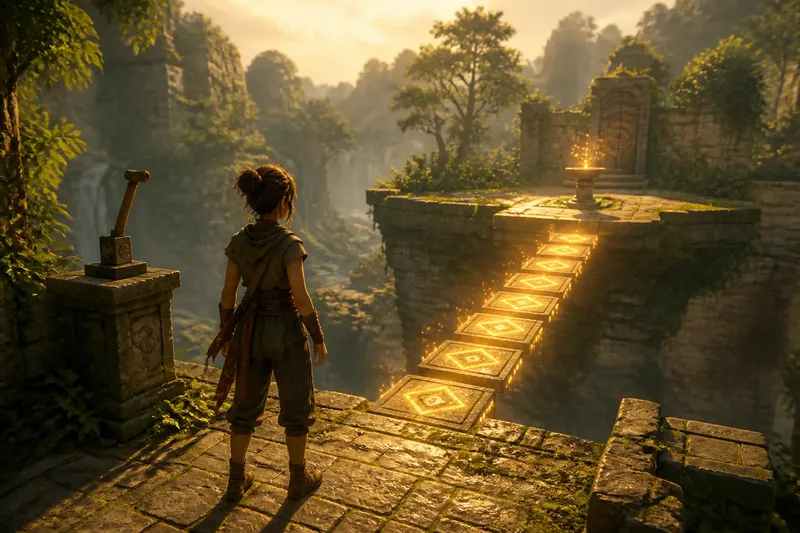
You press a button beside a locked gate, and the character reaches for its handle. In a game tutorial, that small attempt can teach a control while keeping the player inside the scene. Why game tutorials teach by letting you try comes down to a useful link: the player acts, sees a consequence, and begins to understand the rule.
That link can be designed in several ways. A game can show a move, create a low-risk place to practice it, or let the player infer a rule from the environment. Each method offers a different balance of clarity, pacing, and independence.
Show the action
A direct tutorial demonstrates a move and invites the player to repeat it. A companion might climb a ledge before the player follows, or a prompt might show which button makes the character jump. The important part is the connection between input and visible result: the player can see what happened and try the same action.
This works well for controls that will soon matter. A platform game might introduce jumping on a broad path before the player reaches a gap. The lesson stays focused, and the low-pressure setting gives the player room to connect the button with the movement.
A character can also make the instruction feel native to the story. A companion who calls out a route or demonstrates a maneuver gives the player a reason to pay attention beyond the prompt itself. But if dialogue repeats information the player already understands, the character can start to feel like a manual in costume.
Practice without pressure
A game can teach through a small challenge rather than a direct explanation. The player uses a new ability to reach a goal, but the space offers room to try again. A training room, a reversible puzzle, or a quiet stretch of terrain can make the ability’s effects clear without turning a mistake into a major setback.
This approach suits skills that depend on timing or adjustment. A player may need to learn how far a dash carries the character or how an aiming control responds to movement. Repeated attempts make those qualities visible in a way a button prompt cannot.
Say you are designing an invented game with a new dash ability. The starting inputs are a character at the edge of a calm courtyard, a short dash control, and a row of floor tiles that light up when crossed. The player presses the dash control, sees the tiles illuminate, then tries again to reach a nearby platform. The resulting decision is whether the ability’s distance and direction are clear: if the platform is reachable and the illuminated path makes the effect legible, the game can move on; if the character repeatedly stops short with no useful feedback, the designer can widen the landing area or add a visible endpoint cue.
Practice should leave space for curiosity. If every attempt is judged as right or wrong, players may focus on avoiding failure instead of noticing how the ability behaves. A forgiving setting lets them explore secondary effects while keeping the main goal understandable.
Let the world teach
Environmental teaching gives clues through objects, spaces, and character reactions. A lever beside a blocked passage suggests a possible interaction; an enemy that turns toward a sound hints at a relationship between noise and danger. The player experiments, then reads the result.
This method fits stories built around investigation or uncertainty. It lets players form an understanding rather than receive every rule in advance. To make that process fair, the game needs readable feedback: an animation, sound, or change in the environment should help distinguish a failed guess from an action the game did not register.
Discovery can become frustrating when a rule must be understood quickly. If a player enters a tense encounter without knowing which control matters, the challenge may feel arbitrary rather than dramatic. A short prompt or an earlier demonstration can clarify the essential rule while leaving optional details for the player to uncover.
Choose a teaching method
Match the tutorial to the kind of knowledge the player needs and the cost of confusion. A control used throughout the game may need a clear demonstration and a chance to practice. A rule tied to a mystery may benefit from environmental clues, while a move needed in a fast scene may deserve a concise introduction beforehand.
Use these checks to decide how much guidance a scene needs:
- Observe whether the player must use a new control immediately; if yes, demonstrate it before the demanding scene, and if no, allow a lower-pressure discovery first.
- Observe whether the action produces a visible or audible result; if yes, let that feedback carry part of the lesson, and if no, add a clear response or a brief prompt.
- Observe whether a failed attempt blocks progress; if yes, make the rule clearer or provide a forgiving retry, and if no, leave room for experimentation.
- Observe whether the player needs to repeat or refine a skill; if yes, provide a safe practice space, and if no, avoid adding a drill that delays the scene.
- Observe whether uncertainty supports the story; if yes, use clues that invite interpretation, and if no, explain the essential rule directly.
- Observe whether a prompt repeats something the player has already done successfully; if yes, remove or shorten it, and if no, keep it until the action is understandable.
Agency means the sense that a player’s actions have understandable consequences. A tutorial supports agency when it gives an action a purpose in the scene and shows what that action changes. It weakens agency when the player is made to perform a scripted gesture without a reason they can recognize.
Which tutorial fits?
Why do tutorials use playable actions?
A playable action connects a control to an immediate result, so the player can learn in context. It can also make instruction part of what the character is doing instead of pausing the scene for an explanation.
Should a game explain every rule?
No. Some rules are more satisfying to infer, especially when noticing them is part of the intended experience. The game should still give enough feedback for players to tell whether an experiment worked and what changed.
When is a prompt better than discovery?
A prompt helps when the player needs a control before a time-sensitive scene or when the action has no obvious environmental clue. Without that guidance, guessing may feel arbitrary rather than curious.
How can a tutorial fit the story?
Give the action a reason in the scene: a character needs help, a route is blocked, or an object reacts to an attempt. Then the player’s new understanding belongs to the encounter rather than to a detached lesson.
Make learning part of play
The choice is not simply between instruction and no instruction. Demonstration, safe practice, and environmental discovery offer different balances of clarity and independence, and each suits a different rule or scene.
Why game tutorials teach by letting you try is that an attempt turns an explanation into an encounter. When the player can connect an action to its consequence, the tutorial becomes part of the character’s activity. Keep that connection readable, and the player can carry the lesson forward without losing the story’s momentum.